You spot an empty Highland track on the map, a hot spring in the middle of nowhere, and suddenly the big question becomes very real: can tourists drive F roads in Iceland? The short answer is yes. Tourists can legally drive many F-roads, but only if they have the right vehicle, the right conditions, and enough judgment to turn around when Iceland says no.
That last part matters more than people expect. F-roads are not scenic shortcuts. They are mountain roads in Iceland’s Highlands, usually rough, unpaved, seasonal, and often crossed by rivers. If your plan is freedom, they can absolutely deliver it. If your plan is to treat them like regular roads, they can ruin a trip fast.
Can tourists drive F roads legally?
Yes, tourists are allowed to drive F-roads. There is no special Icelandic license just for visitors, and you do not need a guide simply because you are a foreign traveler. The legal issue is not whether you are a tourist. It is whether you are driving a vehicle approved for that road.
In Iceland, F-roads are restricted to 4×4 vehicles. If you take a standard two-wheel-drive rental car onto an F-road, you are breaking the rules and very likely breaking your rental agreement too. That can leave you with serious repair costs and no insurance help when something goes wrong.
So the real answer to can tourists drive F roads is this: yes, but not in just any rental car, and not in every condition.
What makes an F-road different?
The F stands for fjall, which means mountain. These roads lead into Iceland’s interior, where the terrain gets rougher and services disappear. Expect loose gravel, potholes, sharp rocks, washboard surfaces, steep sections, narrow passages, and sometimes unbridged river crossings.
Some F-roads are relatively manageable in a proper 4×4 during good weather. Others are a much bigger commitment. Road numbers alone do not tell the full story. One route may feel like a bumpy gravel road. Another can involve deep water, rough lava fields, and hours without cell signal or traffic.
That is why locals and experienced rental companies talk less about what is technically allowed and more about what is sensible.
The vehicle matters more than the label
A 4×4 badge is the starting point, not the whole answer. Some 4×4 vehicles are well suited for easier Highland routes but not for deep river crossings or badly damaged tracks. Ground clearance, tire condition, weight, and your confidence behind the wheel all matter.
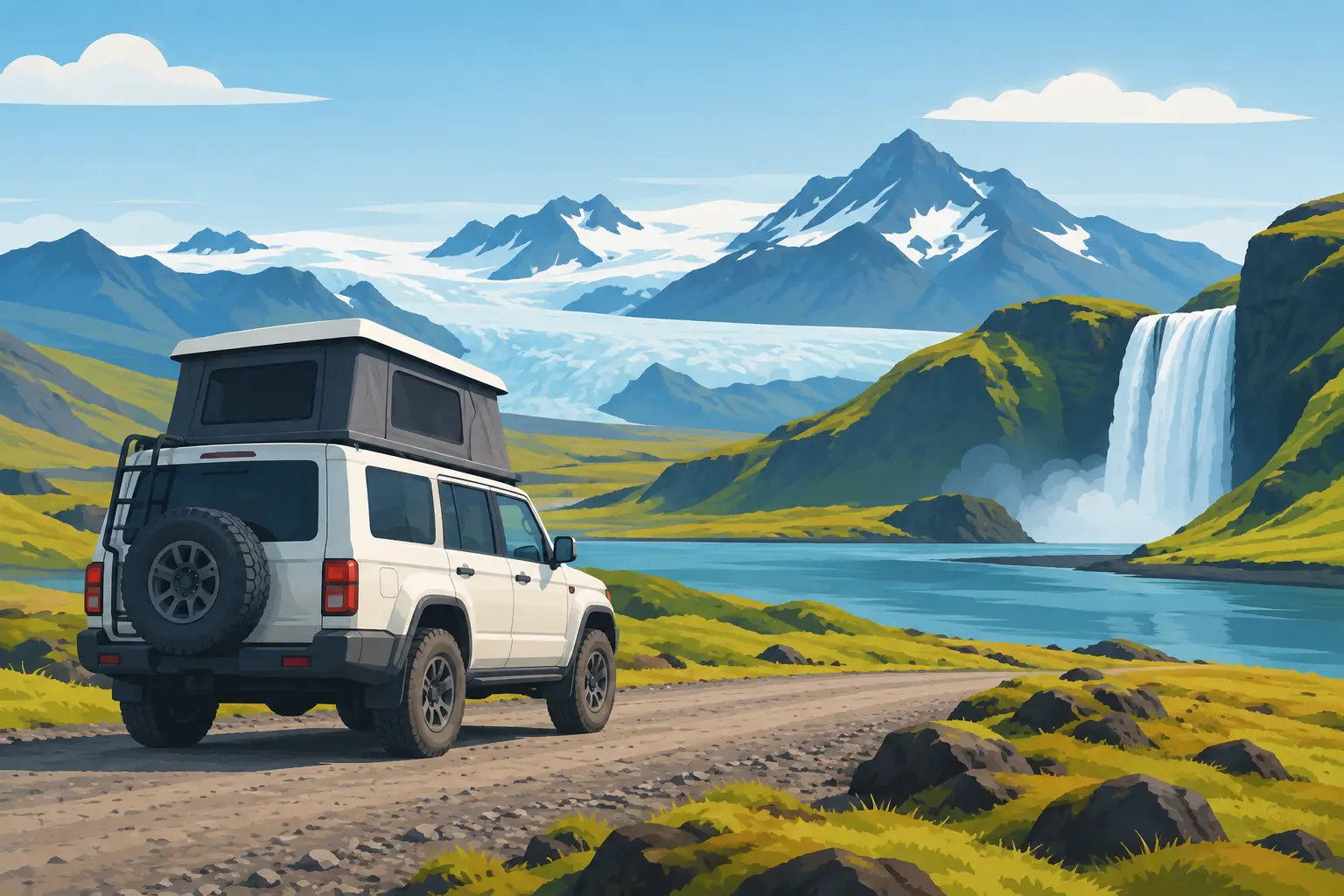
If you are planning to explore the Highlands, choose a vehicle built for Icelandic conditions, not just a car that happens to have four-wheel drive. A rooftop tent 4×4 or a practical sleep-in-the-back 4×4 setup often makes more sense than a larger, heavier camper that is restricted from certain roads or less comfortable on rough terrain.
This is where travelers get caught out. They hear that a route is open, assume any 4×4 will do, and find out too late that open does not mean easy.
River crossings are the real line
For most visitors, the biggest risk on F-roads is not the gravel. It is the water.
Many Highland roads include unbridged river crossings, and water damage is commonly excluded from rental insurance. That means one bad decision can become very expensive. Even experienced drivers treat river crossings carefully because depth changes with rain, temperature, and glacial melt. A river that looked manageable in the morning can be a problem later in the day.
If you have never crossed a river in a 4×4 before, that is not the skill to improvise on vacation. Some F-roads can be enjoyed without major crossings. Others should be left alone unless you are very comfortable judging current, depth, entry points, and exit lines.
A simple rule helps here: if you are unsure, do not cross. Wait for another vehicle, assess the situation, or turn back. There is no shame in that. In Iceland, turning around is often the smart move.
When are F-roads open?
F-roads are seasonal. Most open in summer, usually sometime between June and July, depending on snow, thaw, and road repairs. They begin closing again in early fall as conditions worsen. Outside that window, many are simply shut.
Even in peak summer, openings change. One road can be open while the next section is closed. Weather can shift quickly, and closures happen for good reason. Soft ground, flooding, snow, and damage from runoff can make a route unsafe within hours.
Before heading inland, check official road conditions the same day, not just when building your itinerary. Build flexibility into your trip. The Highlands reward people who can adapt.
Can first-time visitors drive F-roads?
Yes, some can. But it depends on the route, the weather, and your comfort level.
If you are a first-time visitor who regularly drives gravel roads, understands that speed is the enemy on rough surfaces, and chooses easier F-roads in good conditions, you may be fine. If you have never driven off pavement, never handled a 4×4, and feel pressure to reach a specific destination no matter what, you should be more cautious.
A lot of problems start with bad assumptions. Travelers think Iceland is small, roads are simple, and summer means safe. Then they hit fog, deep ruts, or a river crossing they did not expect. The Highlands are beautiful, but they are not forgiving of overconfidence.
Start with realistic routes. Give yourself more time than the map suggests. Keep fuel, food, and warm layers with you. And if a road feels beyond your skill, it probably is.
What tourists should check before driving F-roads
If you are wondering whether you are ready, ask a few practical questions before you leave.
First, is your rental vehicle explicitly allowed on F-roads? That should be clear in your agreement. Second, does your planned route involve river crossings, and are you genuinely comfortable with that? Third, what are the current road and weather conditions today, not yesterday? Fourth, do you have enough fuel and supplies to be delayed or reroute?
This is not about making the trip complicated. It is about avoiding preventable mistakes. No queues. No waiting. No surprises. That mindset works on the road too.
Common mistakes tourists make on F-roads
The most common one is assuming a 4×4 makes every road safe. It does not. The second is underestimating river crossings. The third is driving too fast on gravel and washboard sections, which leads to loss of control, tire damage, or undercarriage hits.
Another mistake is relying too heavily on navigation apps. In the Highlands, the shortest route is not always the smartest route, and app timing can be wildly optimistic. Keep your plan simple and avoid stacking too many remote stops into one day.
There is also a mindset mistake that catches people out: treating reaching the destination as the goal, instead of making good decisions on the way. In Iceland, the road gets the final say.
Which F-roads are more realistic for tourists?
Some Highland routes are much more approachable than others, especially in stable summer weather and with a capable 4×4. Roads leading to popular areas can still be rough, but they may suit cautious independent travelers better than deeper interior routes with larger river crossings and longer isolated stretches.
That does not mean they are easy. It means they are more realistic as a first Highland experience. If your aim is to see the Highlands without taking unnecessary risks, choose routes known for fewer technical challenges and ask your rental provider what matches both your vehicle and your experience.
A good rental company will not just say yes to everything. They will tell you where your vehicle makes sense and where it does not.
So, can tourists drive F roads and should they?
Yes, tourists can drive F-roads, and for many travelers it becomes the best part of the trip. The key is to separate access from ability. Legal access is one thing. Safe, sensible driving is another.
If you rent a proper 4×4, stick to routes that match your skill level, respect closures, and treat river crossings with caution, F-roads can open up a side of Iceland that regular road trips never reach. If you want that freedom without unnecessary complexity, a practical Highland-ready setup from a company like Black Sheep Campers keeps things simple.
The best Highland trips are not the ones where you force the route. They are the ones where you read the conditions, trust your judgment, and leave room for Iceland to shape the day.