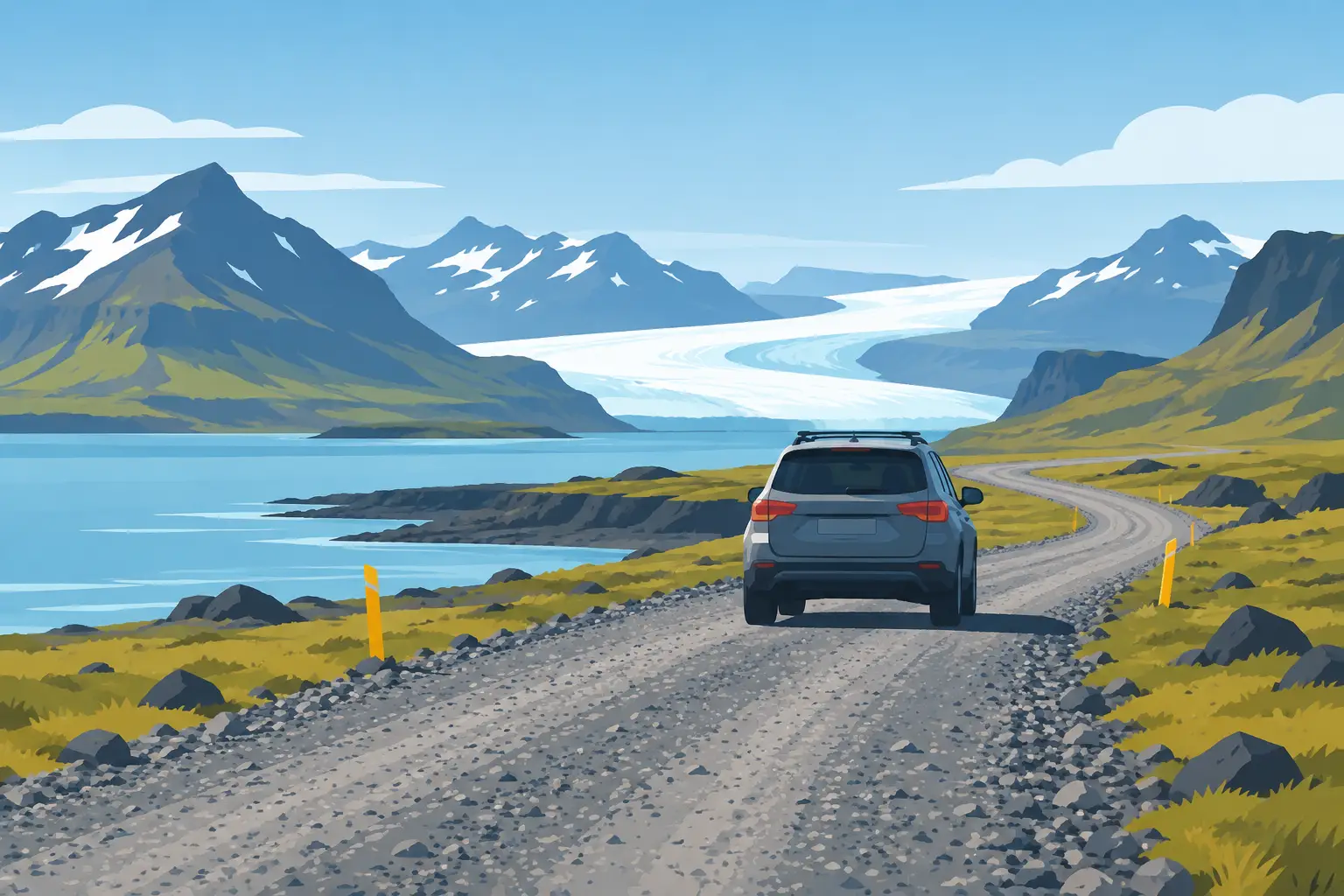
The paved road ends, the landscape opens up, and suddenly you are driving between black volcanic hills with no traffic in sight. To drive Iceland gravel roads well, you do not need rally-driving experience. You need the right vehicle, a slower pace, and enough patience to let the road set the schedule.
Gravel is part of a real Iceland road trip. It leads to quiet fjords, remote waterfalls, mountain valleys, and campsites that sit far beyond the busiest stops on the Ring Road. But gravel also changes quickly with rain, wind, traffic, and the season. Keep it simple: slow down, stay alert, and never treat a gravel road like pavement.
What counts as a gravel road in Iceland?
Not every unpaved road is an F-road, and that distinction matters. Iceland has many ordinary public roads with gravel surfaces. These may connect coastal villages, reach scenic peninsulas, or continue beyond a paved main road. A regular two-wheel-drive car can sometimes use them, depending on road conditions and the rental agreement.
F-roads are different. They are mountain roads, generally found in the Highlands, and they require a 4×4 by law. They are usually open only in summer, often have rough surfaces, and may include steep sections, loose rock, potholes, or unbridged river crossings. An F-road sign is not a suggestion to test your confidence. It is a signal to check the road status, your vehicle’s capabilities, and the rental terms before continuing.
A 4×4 gives you more control and clearance, but it does not make every road safe in every condition. Rain can turn a manageable route into a poor choice within hours. Snow can remain in the Highlands well into summer. If conditions say turn around, turn around. There is always another view ahead.
Choose the vehicle for the road, not the photo
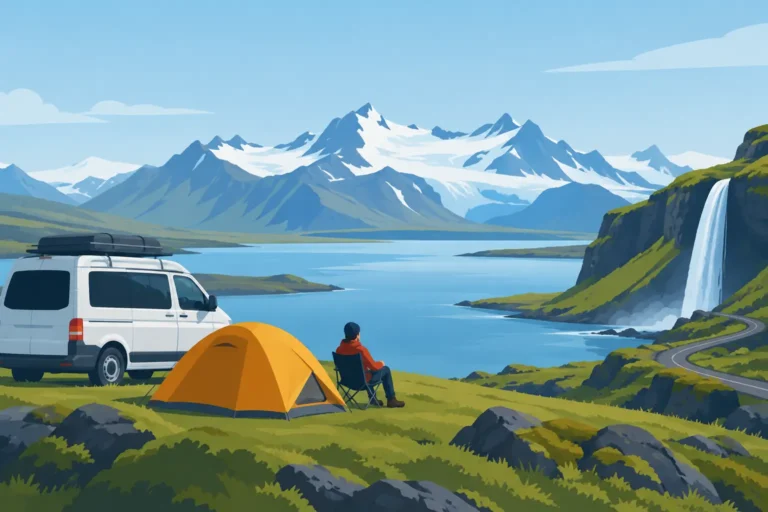
A compact 4×4 is a practical choice for travelers who want the flexibility to leave the main highways and camp independently. It is easier to handle than a large camper, uses less fuel, and is far more suited to uneven gravel than a standard city car.
Still, match the vehicle to your plan. If your route includes maintained gravel roads around Iceland, a capable 4×4 with good tires may be exactly what you need. If it includes deep river crossings or the roughest Highland routes, do not assume that any 4×4 is appropriate. River depth, current, road damage, weather, and vehicle clearance all matter.
At Black Sheep Campers, the focus is on practical 4×4 camping setups that let you combine transport and accommodation without overcomplicating the trip. That freedom works best when you plan realistically. Build a route around roads your vehicle is approved to drive, then leave room to change it when Iceland decides otherwise.
How to drive Iceland gravel roads without damaging the car
The biggest mistake on gravel is carrying paved-road speed onto a loose surface. Your tires have less grip, braking distances are longer, and sudden steering movements can make the vehicle slide. Start slower than you think you need to. You can always increase speed gradually when the road is wide, dry, smooth, and clear.
Iceland’s posted speed limit on gravel roads is commonly 80 km/h, but that is a maximum, not a target. On washboard surfaces, blind curves, loose bends, narrow roads, or rough sections, a much lower speed is the smart option. If the vehicle is bouncing, gravel is hitting the underbody, or you feel like you are correcting the steering constantly, slow down.
Keep both hands on the wheel and look well ahead rather than directly at the hood. Gentle steering is your friend. Brake before the curve, not halfway through it, and accelerate smoothly when exiting. Sharp braking or sudden turns can cause a skid, especially on fresh gravel or wet roads.
Loose stones are another reason to leave a large gap behind the vehicle ahead. Tailgating can crack a windshield or chip paint, and passing throws even more gravel. If you meet another vehicle on a narrow stretch, reduce speed early. Give each other space and avoid sending a spray of stones toward someone else’s car.
Expect blind hills, narrow bridges, and soft shoulders
Many rural roads have blind crests. You cannot see what is coming over the top, whether it is another car, sheep, cyclists, or a stopped vehicle. Ease off the accelerator and stay on your side of the road.
Single-lane bridges are common in Iceland. The general rule is that the vehicle closest to the bridge has priority, but clear communication and common sense matter more than forcing the issue. Slow down well before the bridge, check for approaching traffic, and wait if needed. There is no prize for arriving 20 seconds earlier.
Be careful near the edge of the road as well. Gravel shoulders can be soft, steep, or uneven. Pull over only where there is a clearly safe turnout. Stopping in the middle of the road for a photo is never worth the risk.
Check conditions before every driving day
Iceland road conditions are not something to check once when planning your trip. Make it part of your morning routine and check again before committing to a remote route. Official road updates can show closures, surface conditions, wind warnings, and whether mountain roads are open.
Weather changes fast, especially in the Highlands, Eastfjords, and exposed coastal areas. Strong wind can make doors difficult to control and driving tiring. Heavy rain can create standing water, reduce visibility, and affect river levels. Fog can make a familiar road feel completely different.
Fuel is another practical consideration. Stations are widely available around the main route but much less frequent in remote areas. Do not wait for the low-fuel light before heading onto a long gravel section. Fill up when you have the chance, carry water and snacks, and download offline maps before leaving reliable signal.
Tell someone your intended route if you are heading into a less-traveled area. If conditions force you to change plans, that is normal Iceland travel, not a failed day. A hot spring, a coastal walk, or an extra night at a good campsite can be a better choice than pushing through a questionable road.
Gravel roads are not off-road permission
Iceland’s landscapes can look empty, but they are fragile. Driving off marked roads is illegal and causes damage that can remain visible for decades. Moss, volcanic soil, and tundra recover slowly. Even tire tracks that seem minor can leave a lasting scar.
Stay on designated roads and established tracks, use proper pullouts, and park only where parking is allowed. The same approach applies to camping. A rooftop tent or sleep-in-the-back setup gives you flexibility, but it does not mean you can camp anywhere. Use designated campsites or places where you have clear permission to stay overnight.
This is not about limiting the adventure. It is what keeps Iceland wild enough to explore in the first place.
When an F-road includes a river crossing
River crossings deserve their own level of caution. They are not like driving through a deep puddle. Water level and current can change quickly after rain or warm weather, and a route that was passable earlier may not be safe later in the day.
Never cross a river if you do not know the conditions, if the current looks strong, or if you are unsure whether your vehicle is permitted and equipped for it. Do not follow another vehicle blindly. Its clearance, weight, experience, and route choice may be completely different from yours.
If you are traveling alone and uncertain, waiting for current information or choosing another route is often the best call. Iceland rewards good judgment. The Highlands will still be there tomorrow.
A simple gravel-road routine
Before leaving pavement, reduce your speed and settle into a relaxed pace. Check that your lights are on, secure loose gear inside the vehicle, and make sure you have enough fuel for the route and a detour. Keep your phone charged, but do not rely on it as your only navigation tool.
As you drive, stay aware of changing surfaces. Smooth packed gravel can suddenly become washboard, loose stone, or a pothole-filled section after a bend. Give yourself time to react. The road is not an obstacle between attractions. On the best Iceland trips, it is part of the experience.
Drive with care, respect closures and weather warnings, and choose the road that suits the day rather than the one that looks most ambitious on a map. That is how you reach the quiet places, protect your vehicle, and still have enough energy to enjoy camp when you get there.